
By Kay C Dee
Associate Dean for Learning & Technology
This post is the second in a two-part series on executing strategic initiatives. Read the first one here.
In The 4 Disciplines of Execution, the authors claim that “People give less than their best and finest effort if no one is keeping score — it’s just human nature” (pg 155). I may be revealing too much about myself when I confess that I had a small fit of impotent fury over this (to be honest, brief fits of impotent fury are not uncommon events for me), but the claim in question sounded like an evidence-free assertion at best, and ‘begging the question’ at worst. While constructing fierce internal philosophical arguments on the question of whether one’s best and finest efforts can be intrinsically inspired, I began to mentally challenge the assertion that people “play differently when they are keeping score” (pg. 155).
I am mildly chagrined to report that it does appear that people play differently when they are keeping score. For example, a meta-analysis by Harkin et al., published in Psychological Bulletin and freely downloadable, found that monitoring progress toward a goal promoted the attainment of that goal. Furthermore, “…monitoring progress in public and physically recording progress had larger effects on goal attainment than monitoring that was done in private and not recorded” (pg. 219).
This aligns with suggestions in The 4 Disciplines of Execution about keeping a compelling scoreboard. The authors suggest that the individuals working toward a goal should be the ones who design and use the scoreboard to record/monitor progress (instead of, for example, the person to whom these individuals report). The authors also suggest that these individuals should all be able to see the scoreboard change quickly as measures of progress change.
Continue reading “The 4 Disciplines of Execution – Keeping Score”

 Left — Participants at the 2015 MACH Workshop categorize their problems in different dimensions. What perspective will turn out to be the most productive, in guiding change?So, you may be thinking, for the most sweeping changes, perhaps the broadest possible perspectives can be useful? Well, what are those?
 How is it possible, given that change is the “constant,” that at times change in our organizations is disruptive, appearing to be at odds with organizational culture? Malott adopts the concept of “victim blaming” to explaining this aspect of organizational behaviors. In this case, if an organizational suffers from less than optimal performance or results, there is a tendency to blame those individuals who suffer the most from a poor performing organization, as if they are the culprits. Malott argues that almost everyone in an organization is trying to do a good job, so it is the underlying system that creates successes and failures. And organizations frequently reward individuals who possess perfect track records, rather than recognizing those who try new things with the intent to move the organization forward and perhaps fail.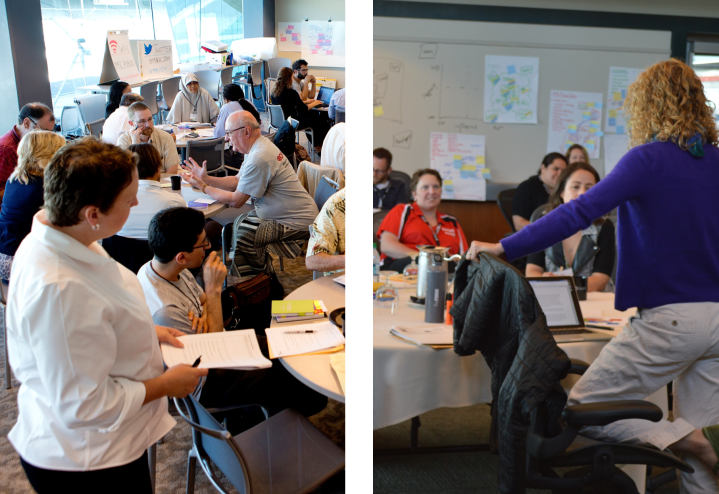


 Making Academic Change Happen